
Project
The SACCADE Project examines how real-world systems actually function—across law, healthcare, governance, and physical environments.
It focuses on a simple pattern: Systems often continue operating even when their outcomes no longer match their purpose.
This work looks at why that happens, where systems break, and what changes when their structure is corrected.
Kelly Driftmier
Complex Systems Theorist | Applied Kinesiologist
How systems form and hold together
The SACCADE framework describes the repeatable sequence through which systems come into existence, stabilize, and evolve. It applies across domains—physical, biological, and social—by identifying how something becomes structured, maintains itself, and persists over time.
Signal → Arrival → Context → Constraint → Adaptation → Distribution → Evolution
- Signal → nonzero flow → Gradient activation
- Arrival → coupled flow → Interaction-dependent constraint formation → State Space
- Context → viable region defined→ Admissible state-space restriction→ Environmental Forcing Space
- Constraint → trajectories bounded → Finite capacity limits → Boundary Condition Space
- Adaptation → correction near boundary → Structural reparameterization under overload → well-posed evolution operator governing state transition
- Distribution → stable propagation→ formally defined failure conditions → In continous time
- Evolution → regime update/failure
Developmental Constraint Theory (DCT)
What makes systems stable
Developmental Constraint Theory (DCT) describes the structural conditions under which systems form, stabilize, and persist.
Across physical, biological, and cosmological domains, organized systems do not arise from gradients alone. Structure emerges when energetic differences are captured by constraint architectures that restrict admissible system trajectories and redistribute energy through ordered processes.
DCT formalizes this process as a required sequence of constraint formation (SACCADE), identifying the conditions that make sustained system behavior possible across scales.
Global Coupling Field (GCF)
How systems connect and continue
The Global Coupling Field explains how systems don’t just exist—they interact, carry energy forward, and connect across space and time. If DCT explains how systems form, GCF explains what happens after they stabilize. Systems don’t end when they complete a cycle. They produce something that continues. That “something” is what allows systems to connect.
How It Fits Together
If DCT explains how systems form, GCF explains what happens after they stabilize: how they connect and persist.
Each layer builds on the one before it. Together, they describe how systems form, stabilize, and interact.
- SACCADE → the sequence (how systems form)
- DCT → the constraints (what makes them stable)
- GCF → the interaction (how they connect)
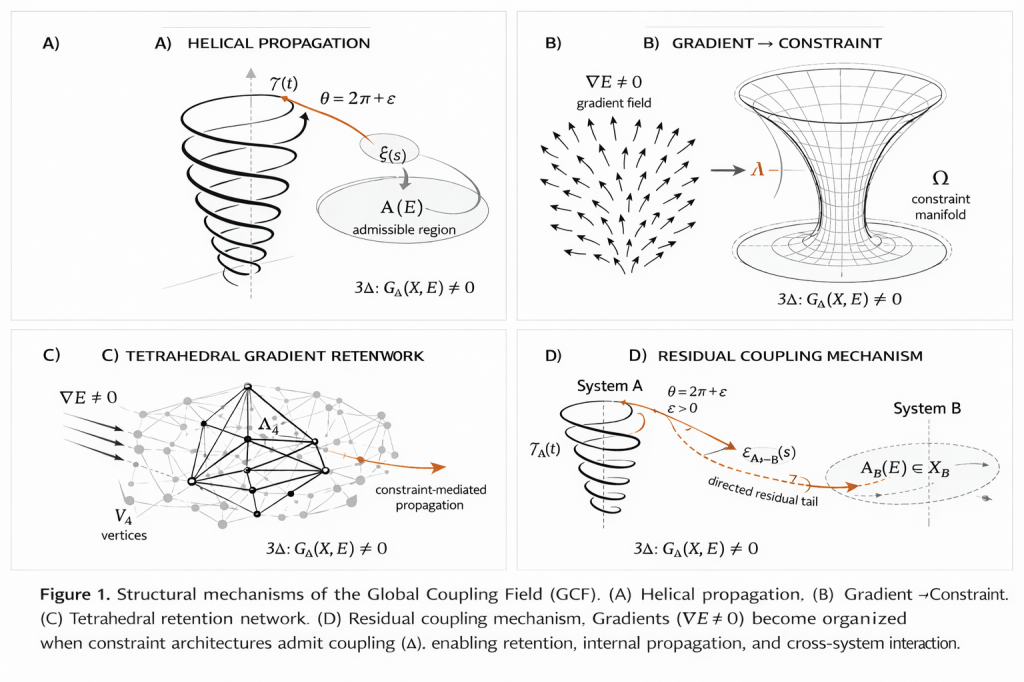
Figure 1. Structural mechanisms of the Global Coupling Field (GCF).
(A) Helical propagation. System trajectories evolve along a helical path γ(t), representing recursive but non-reset dynamics under sustained forcing. Angular progression (θ = 2π + ε, ε > 0) produces a residual state ξ that maps into an admissible region A(E), enabling continued coupling and preventing termination at cycle closure.
(B) Gradient to constraint geometry. A non-zero gradient field (∇E ≠ 0) does not produce persistent organization unless mediated by a structural operator Δ. The operator transforms unconstrained gradients into a constraint manifold Ω, restricting admissible trajectories and enabling sustained system behavior (∃Δ: G_Δ(X,E) ≠ 0).
(C) Tetrahedral gradient retention network. Minimal stable retention of gradients occurs through a tetrahedral architecture Δ₄, defined by four vertices and six edges. This structure provides maximal connectivity in three dimensions, enabling constraint-mediated propagation (G_Δ) while preventing collapse into dissipative flow.
(D) Residual-tail coupling mechanism. Cyclic systems generate residual states due to incomplete closure (ε > 0). These residuals propagate directionally (ε_{A→B}) and enable coupling between systems when admissibility conditions are met (G_Δ(X,E) ≠ 0). Decoupling occurs when structural operators fail to sustain the interaction gradient.
Across all panels, persistent system formation requires that gradients be captured, constrained, and propagated through structural operators. In the absence of Δ, gradients dissipate without producing stable organization.
Publications
The full theoretical work is available on Zenodo repository.
- SACCADE Framework
- Developmental Constraint Theory (DCT)
- Global Coupling Field (GCF)
Kinetic Systems Analysis (KSA)
How systems are evaluated in reality
Kinetic Systems Analysis applies these principles to real-world systems—showing how structure, energy, and behavior interact in practice. The theory defines how systems work.
The theory defines how systems work. The civic posts show what happens when those rules are followed—or violated.
Analysis in Action
Civic Systems – In Practice
How systems behave in practice-law, healthcare, governance, and immigration.
Start With: When the Math Stops Adding Up
Theory – Structural Instantiations
How systems form, stabilize, and interact across domains.
Start With: The Theory

